RagottoThe agent that goes back to the source.

Enterprise search and agents

Answers from your documents, cited to the page.

Ragotto searches and reasons over your organisation’s documents. Every answer points to the exact page it relies on, every access right is enforced, and every step can be traced. The engineering keeps it light enough to run on your own servers.

The demo runs on 499 public NASA technical reports.

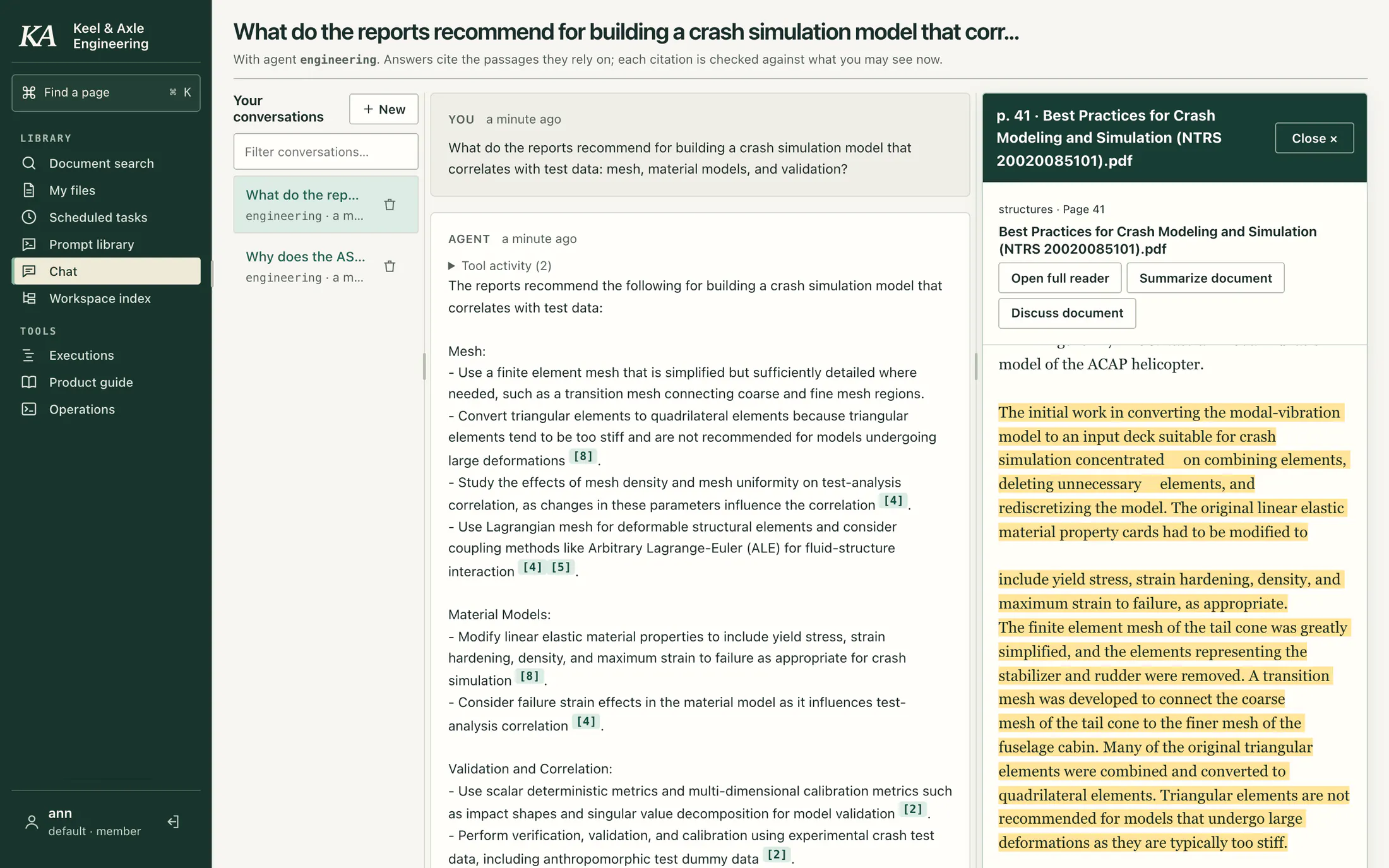
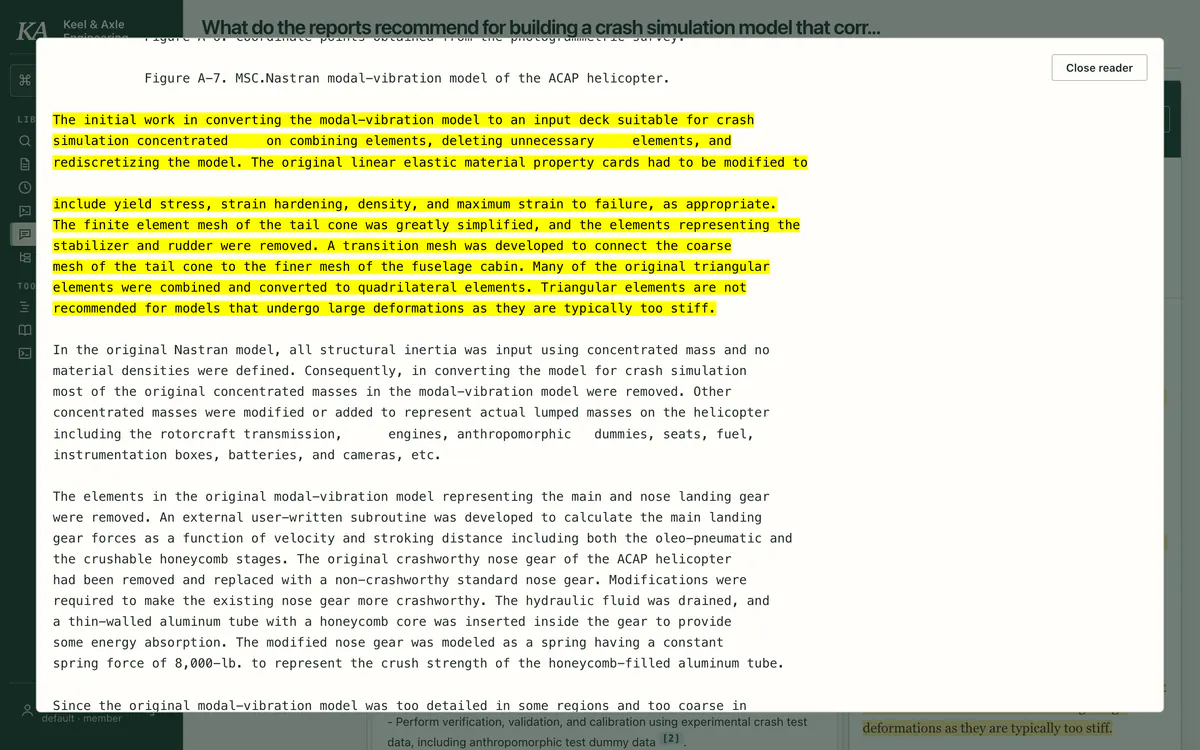
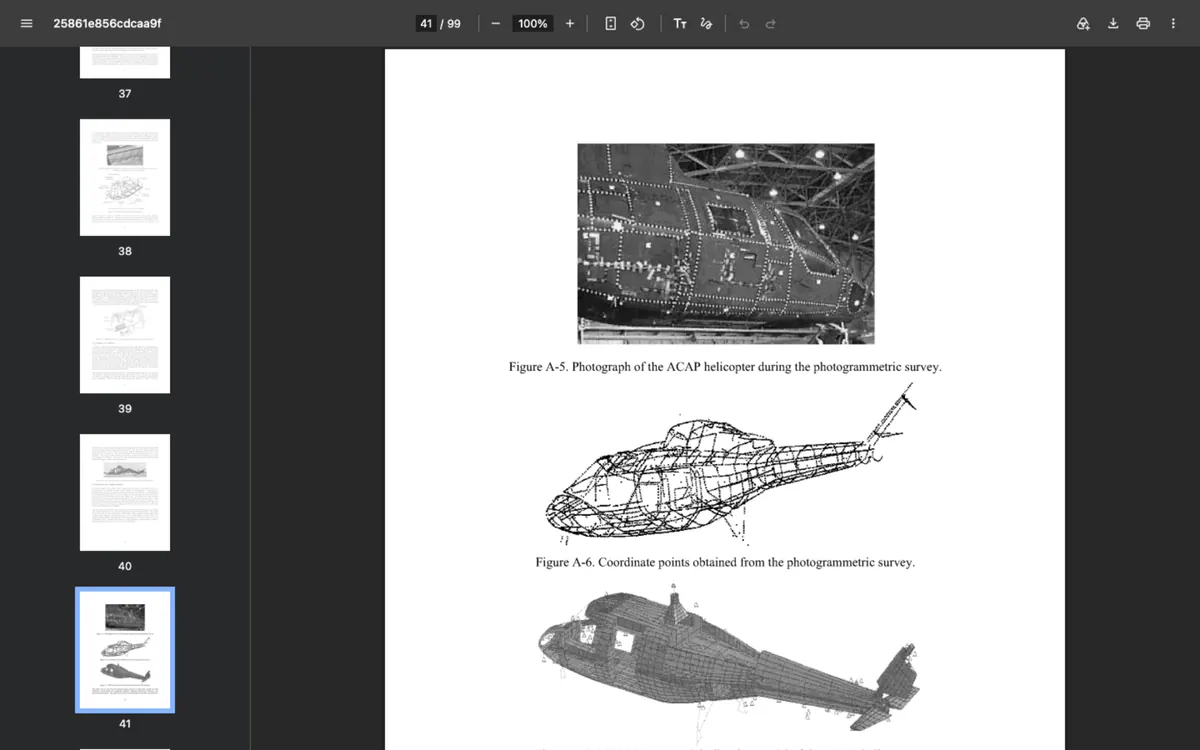
The chat of Ragotto: an answer about crash simulation models with numbered citations; citation 8 is open beside it at page 41 of a NASA report, the passage highlighted.
Documents: NASA Technical Reports Server (ntrs.nasa.gov), public use permitted

Measured, not promised.

How we measured
  • 38 min 40 s

    10,000,000 documents made searchable on one 8-vCPU node, about 4,310 per second

    Made-up records · Azure E8ds_v4 · whole pipeline

  • 39–103 ms

    median query time over 100,000,000 passages on one machine

    Engine alone · synthetic corpus · 8 vCPU

  • 8 min 21 s

    to restart with 10,000,000 documents already indexed

    Same node · journal replayed

  • < 200 MB

    of server memory for the NASA demo: 499 reports, 12,631 pages, hybrid search and chat

    1.2 GB on disk · measured locally

Whether you have 100 files, a thousand, ten million or a hundred million, Ragotto is for you.

Answers you can check

Every claim leads back to its page.

Answers cite the passages they rely on. Open a citation and you land on the passage, highlighted in the full text of the report; one more click opens the original PDF at the cited page. Each citation is checked again against what the reader may see at the moment it is opened.

  1. 1The answer cites page 41
  2. 2The passage, highlighted in the full text
  3. 3The original PDF, open at the cited page
The full reader with the cited passage of the crash modelling report highlighted.
The original PDF of the report opened at page 41, showing a helicopter crash model.

Documents: NASA Technical Reports Server (ntrs.nasa.gov), public use permitted

Search

Search that reads like an engineer.

Keyword precision and semantic recall in one ranking. Every passage knows its document, its section and its page, so a result is a place you can open, not just a file name.

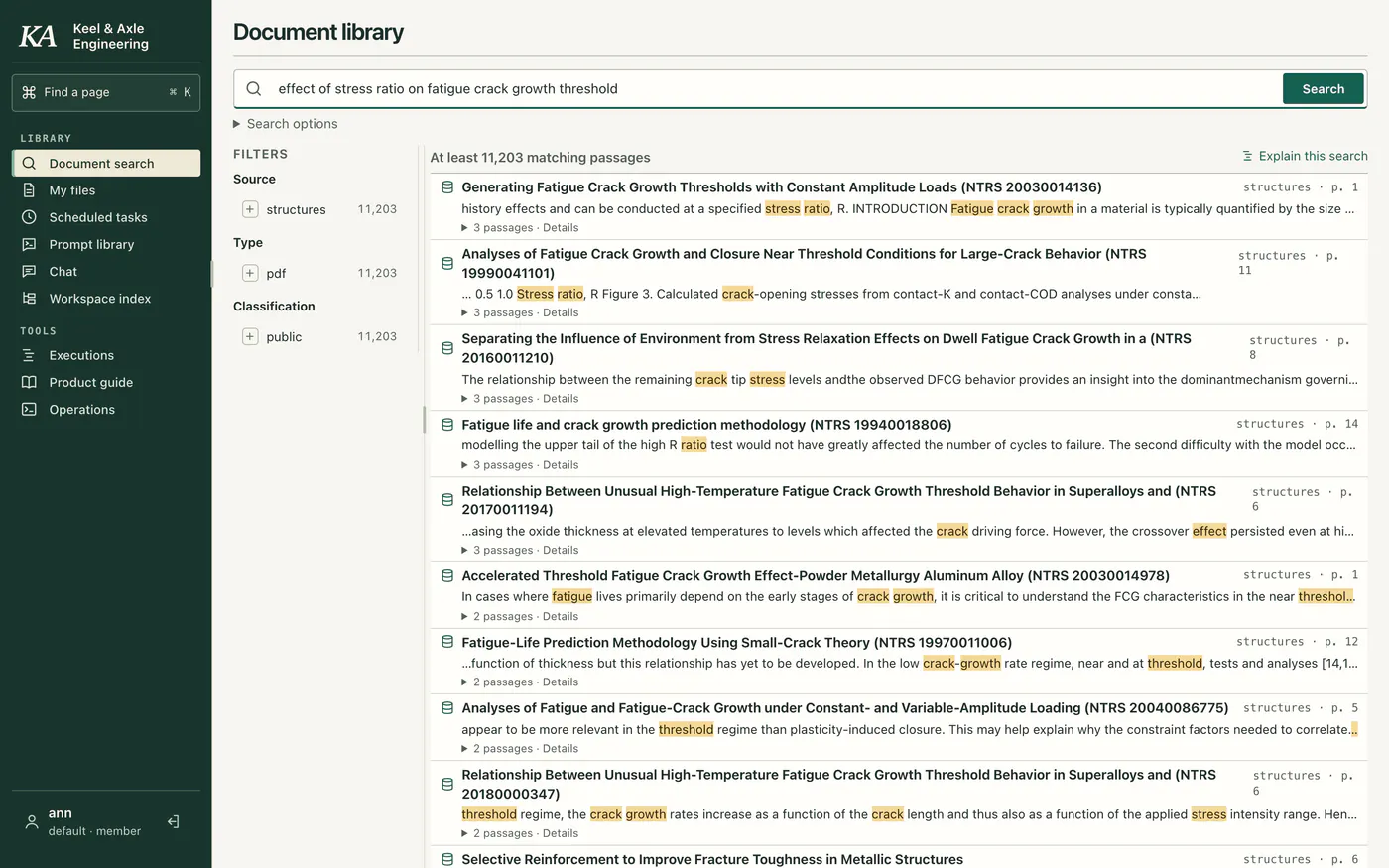
Document search for fatigue crack growth thresholds: results with their source and page, filters on the left.
  • Hybrid search with pages

    Keyword and meaning combined; results grouped by document with the page of each passage.

  • Figures and scans

    Figures inside PDFs are found and captioned, scanned pages are read by OCR, and page images can be shown to a vision model.

  • Structure kept

    A section change starts a new passage, a page break does not: a table that runs over two pages stays one piece and knows both pages.

  • Compare retrieval

    Run two search configurations side by side as the current user, and see which one finds the right page.

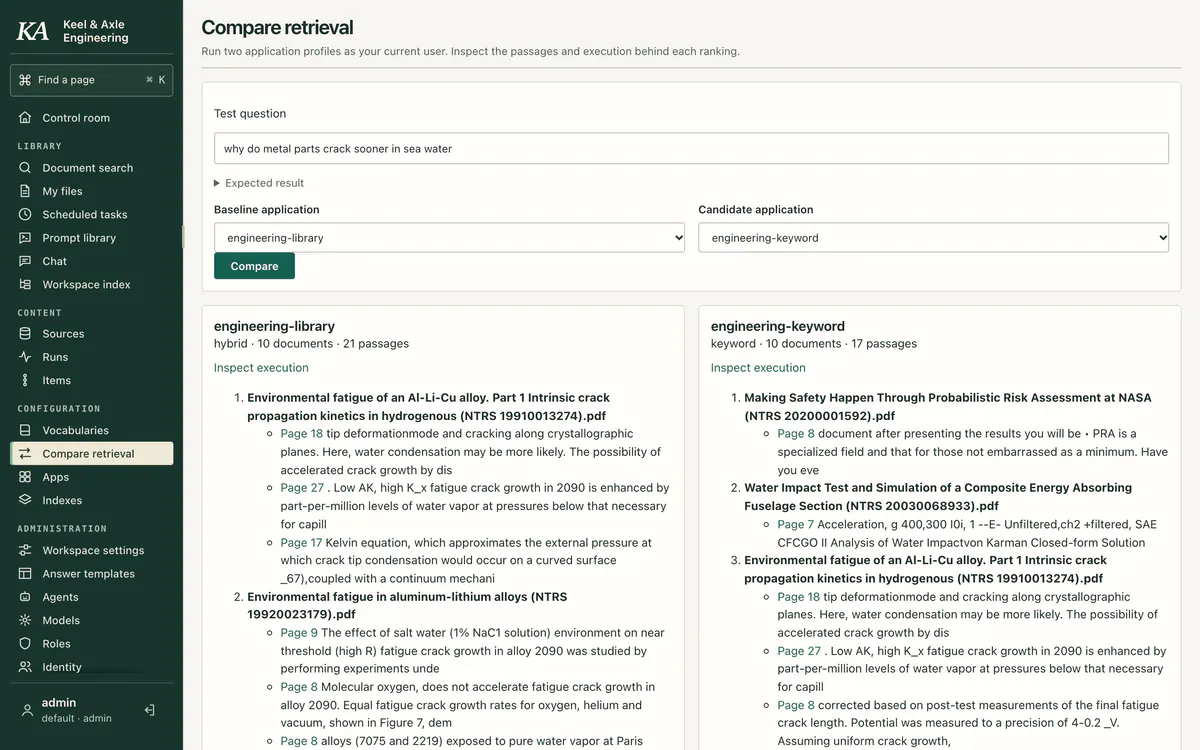
Compare retrieval: hybrid and keyword search side by side on the same question.
“Why do metal parts crack sooner in sea water?” Hybrid finds environmental fatigue in salt water; keyword alone does not.

Documents: NASA Technical Reports Server (ntrs.nasa.gov), public use permitted

Images and knowledge

Figures, scans and the concepts of your field, all searchable.

Text is only part of a document. Ragotto finds and reads the figures, reads scanned pages, shows pages to vision models, and recognises the concepts of your own vocabularies in every passage.

Illustration: a figure on a PDF page becomes a search result with its thumbnail and its page. p. 41

Multimodal

  • Figures in PDF and Office files are found, classified, read and captioned; each is a search result with its page and a thumbnail.
  • Scanned pages are read by OCR and become passages with their page numbers.
  • The pages an answer relies on can be shown to a vision model, so tables, formulas and drawings keep their meaning.
  • Put a photo in the chat or search with an image: Ragotto searches your documents from what it sees.

40 NASA reports, 1,017 pages: 2,327 images found, 175 kept as figures; 184 s and 0.035 USD of model calls per 1,000 pages, on a development machine.
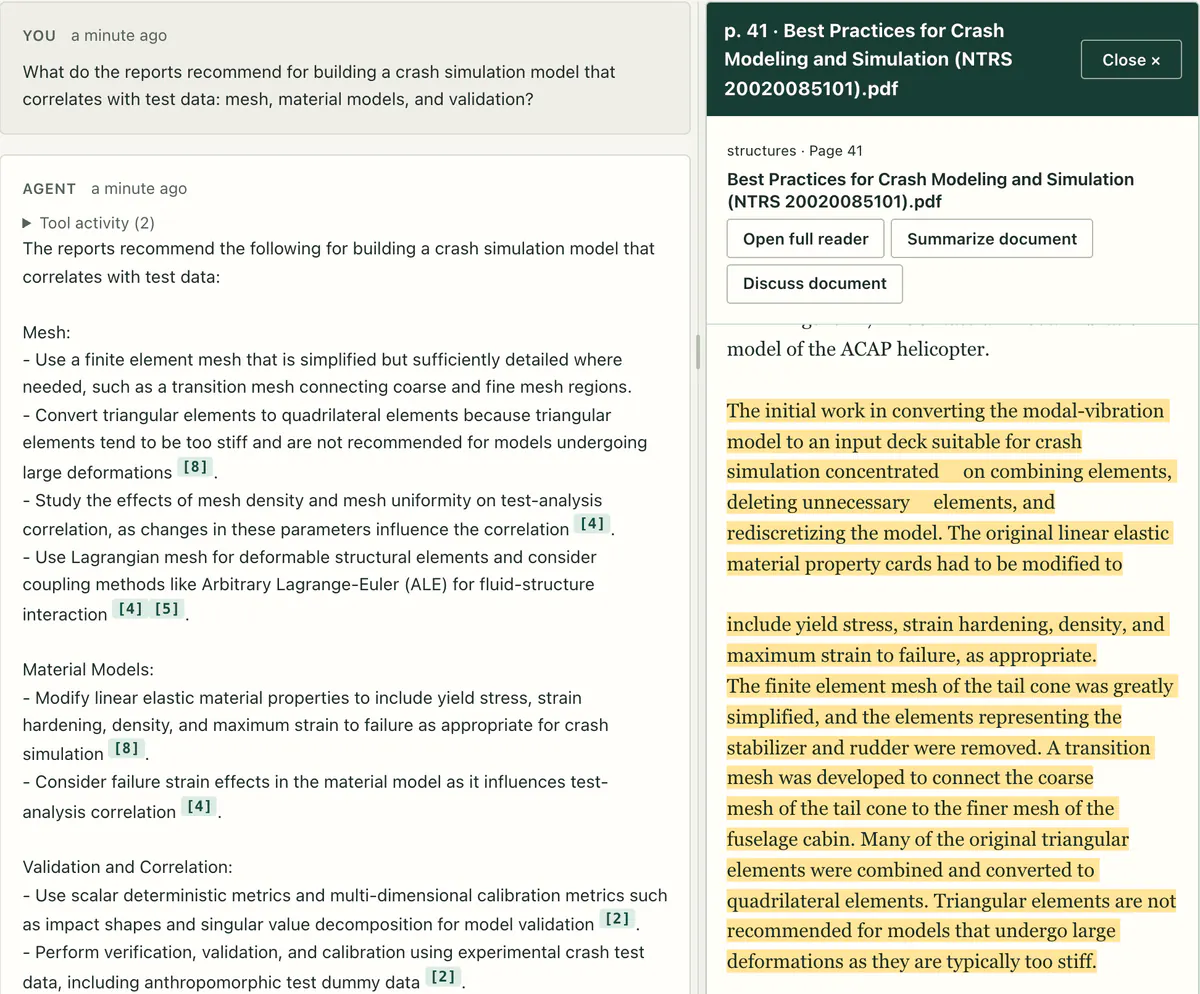
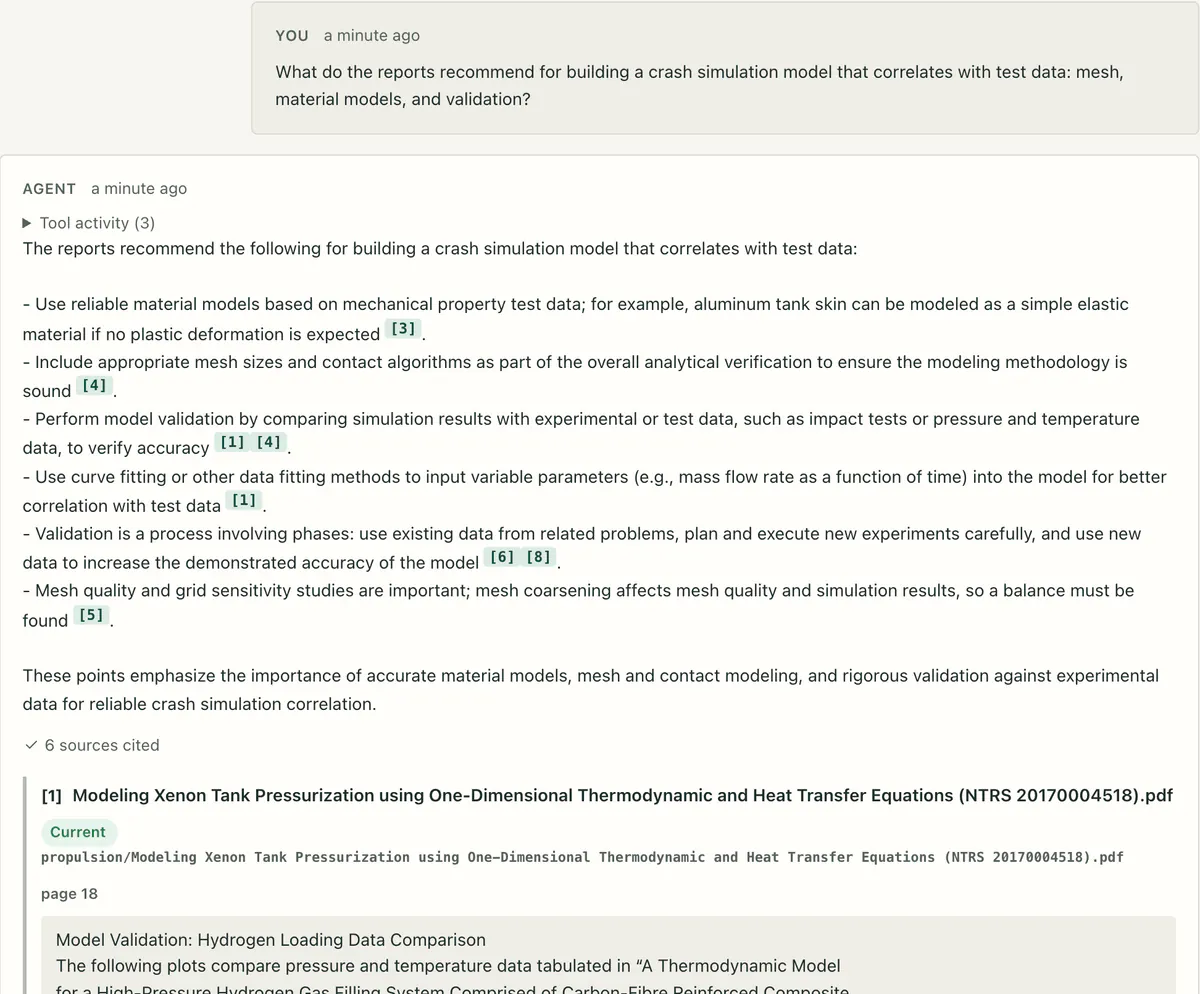
Illustration: a concept and the concepts that appear with it, with the number of passages linking them. Energy absorption Composite structures Landing gear Seats 14 9 6 4 Crashworthiness

Knowledge graph

  • Your vocabularies, written by hand or imported from SKOS and OBO, are recognised in every document as entities and concepts.
  • Ask for a concept and find it under its other names and its narrower concepts.
  • Explore the concepts that appear with an entity, counted over the passages you may read, each with its evidence.
  • Annotation profiles are measured before they are published, and access rights apply in the graph as everywhere else.

BC5CDR test set, 500 PubMed abstracts, MeSH as the vocabulary: entity retrieval recall 84.1%.

Connectors

Your content, where it already lives.

Each connector lists items, their versions and their access lists; change detection, deletions, retries and checkpoints belong to the platform.

  • File shares

    Local and mounted folders, with an access list for each source.

    filesystem

  • Uploads and personal files

    Documents people upload themselves, visible to them alone.

    upload

  • Object storage

    S3-compatible buckets and Azure Blob containers, crawled like a folder tree.

    objectstorage

  • Web sites

    Sites crawled from the addresses you give, robots.txt respected.

    web

  • JSON, XML and REST feeds

    Records from JSON or XML files or a REST API, each a document with its own id, title, text and access lists; field names can be remapped. REST over HTTPS with a token kept as a secret, pages followed on the source’s origin only, private networks refused unless allowed.

    json · xml · rest

  • PostgreSQL

    Rows of a read-only query with an access list per row; later crawls read only changed and deleted rows.

    postgres

  • Microsoft 365

    SharePoint libraries and OneDrive, each document with its own access list; after the first crawl, only changes are fetched.

    microsoft365

  • Confluence

    Pages, blog posts and attachments, with space permissions and page restrictions.

    confluence

  • Jira

    Issues and their comments, with browse permissions and security levels.

    jira

Every connector carries the source’s access rights for each document, crawls incrementally and passes the same conformance suite. Large sources can be split into partitions.

Every connector in the product is ours: written, tested and maintained by our team. You get its source code and a development kit to build your own, and we write any connector you need.

Access rights and traceability

Same question, two people, two answers.

Access lists come from the source and are enforced inside the search engine, on every path: search, chat, citations, counts and traces. Nobody gets an answer built from a document they could not open.

annstructures team

ann’s answer, with a citation open on a structures report at page 41.
Cites Best Practices for Crash Modeling and Simulation, page 41.

bopropulsion team

bo’s answer to the same question, citing propulsion reports only.
The same question, answered from propulsion reports only.

From an answer to the source, and back

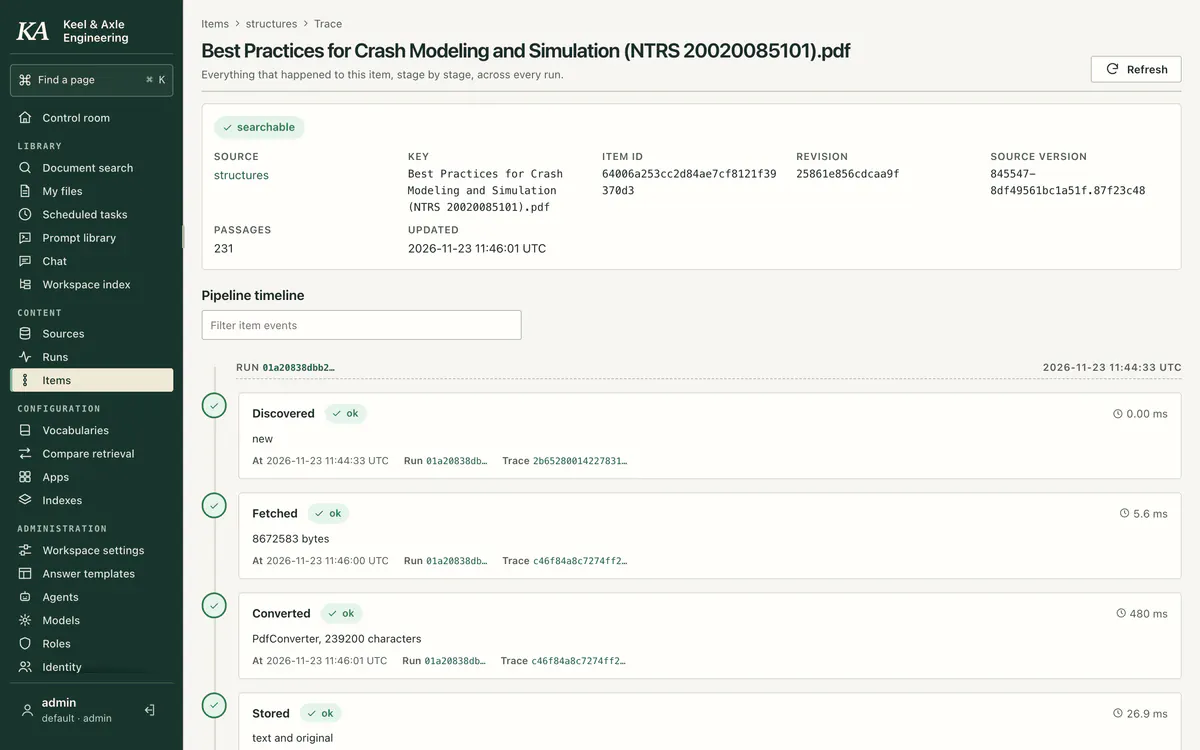
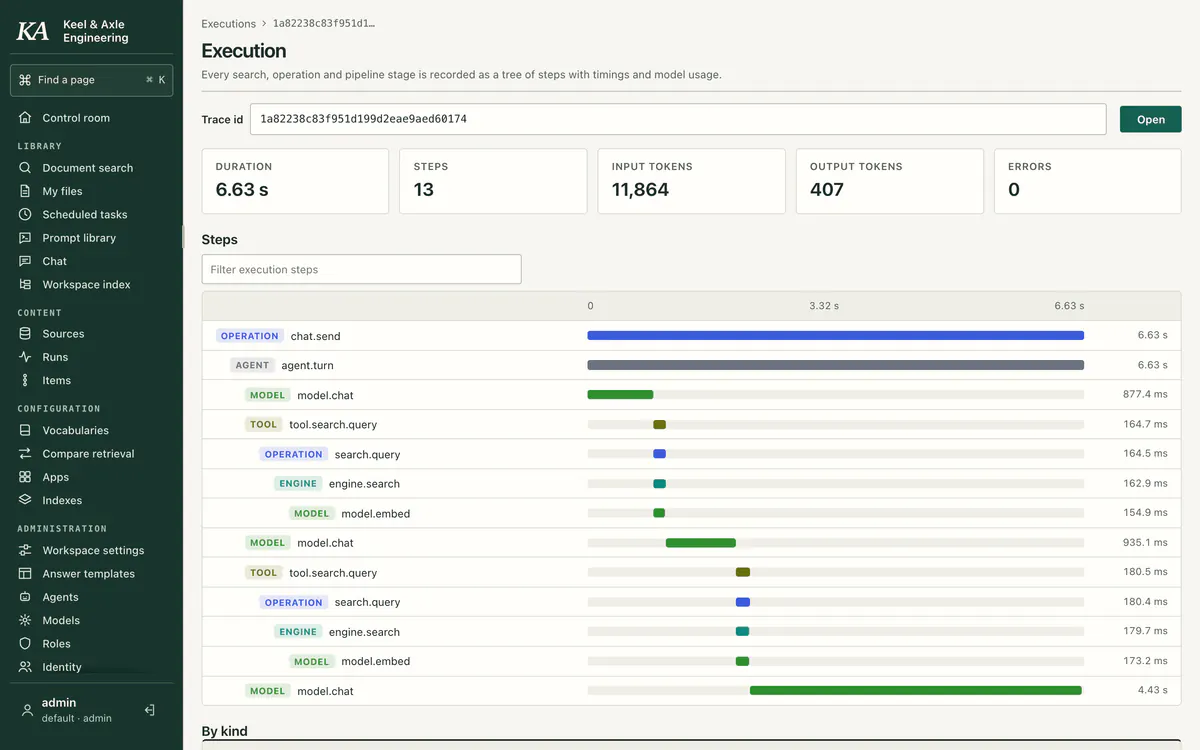
Every item has a ledger of what happened to it: discovered, fetched, converted, indexed, with durations and trace ids. Every chat turn has an execution trace: each search, each model call, each token counted.

We know exactly how long every step and every call takes, and how many tokens go into and come out of each model call.

  • Access enforced in the engine, on every retrieval path
  • Delegation recorded: an agent acting for a person is named with that person
  • Tamper-evident audit trail: an edited, removed or reordered record is detected
  • Personal data redacted or pseudonymised before it reaches a model
The ingestion ledger of one report: discovered, fetched, converted, stored, each with its duration.
Ingestion ledger
The execution trace of a chat turn: 13 steps, 3 model calls, 2 searches, token counts.
Execution trace

Documents: NASA Technical Reports Server (ntrs.nasa.gov), public use permitted

Agents

Agents that act, with a person in the loop.

Agents search, read and use tools on behalf of the person who asks, with that person’s rights and nothing more. Every action is one operation, the same through the interface, the REST API, MCP and the command line.

Ask Ragotto to find the incidents of machine 73.

Fetch!

One operation, every door

CLI  al search.query --text "crack growth threshold" --top 3
REST POST /api/v1/operations/search.query
MCP  tools/call search_query  X-Al-On-Behalf-Of: ann
  • Tools with approvals

    An agent proposes; a person approves before anything is changed. The approval is stored, so it survives a restart.

  • MCP for your other agents

    Third-party agents connect over MCP and act on behalf of a user, in the same trace and the same audit trail.

  • Scheduled tasks

    A question asked every morning, a report every week: the answer waits for you, with its citations.

  • Your prompts

    A prompt library for the workspace, and agents whose instructions, tools and models you choose.

Runs where you want

Your servers, your keys, your models.

A cross-platform .NET application on ASP.NET Core with very few dependencies. Install it natively on Linux, macOS or Windows, or run the container image with its Helm chart. One node holds everything; a cluster shares its state in PostgreSQL.

  • Native on Linux, macOS and Windows
  • Container image and Helm chart, no custom operator
  • Single node, or a cluster on PostgreSQL with failover
  • Local model servers or API providers, with your own keys
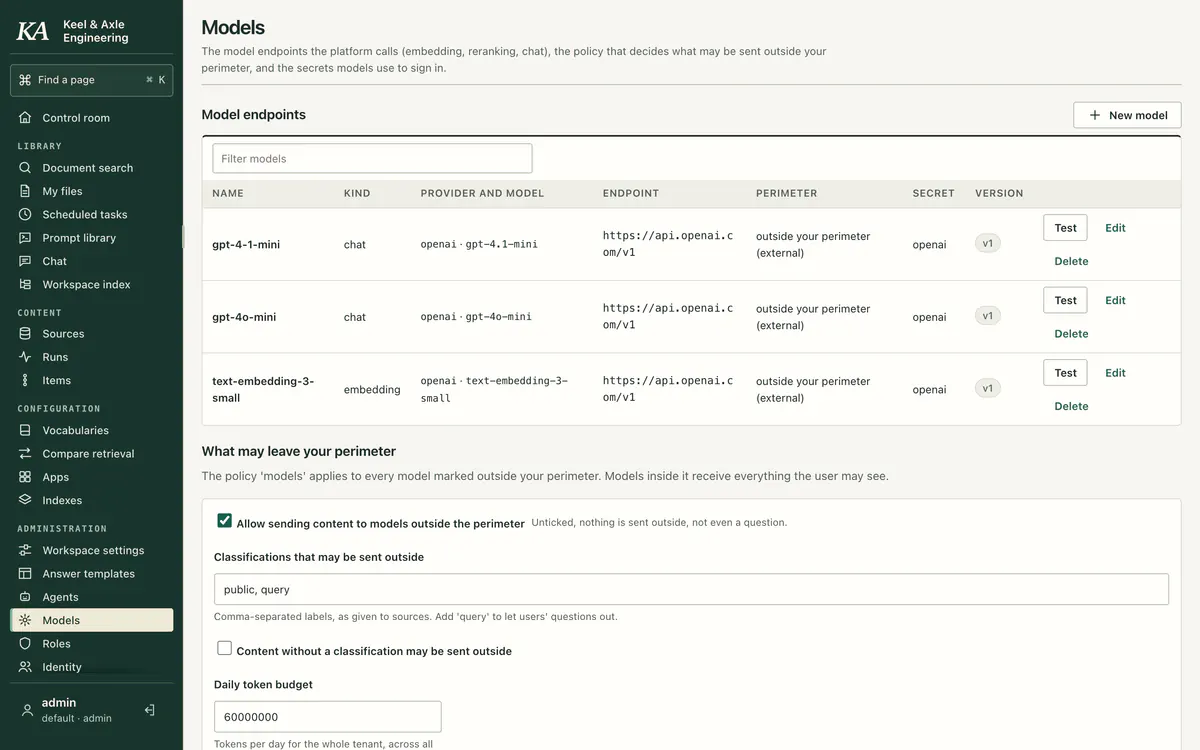
  • A policy decides which documents may reach an external model
The models page: OpenAI endpoints marked outside the perimeter, and the policy letting only public content leave.
Models, and the policy for what may leave your perimeter.

One node: everything in one process

One node: everything in one process Architecture: your sources feed the ingestion pipeline, which feeds the search engine; agents and the API serve people and other agents, and reach models through the model gateway. Your sources SharePoint, Confluence, Jira S3, Azure Blob, PostgreSQL People and agents with their own rights Ragotto Ingestion pipeline ledger and conversion OCR, figures, pages Agents and API REST · MCP · CLI web interface Search engine keywords and vectors access lists in the index Model gateway egress policy, quotas keys kept on the server Embedded store in the data directory Your models local or by API One node: everything in one process Architecture: your sources feed the ingestion pipeline, which feeds the search engine; agents and the API serve people and other agents, and reach models through the model gateway. Your sources SharePoint · Confluence · Jira · S3 · … Ragotto Ingestion pipeline ledger and conversion Search engine access lists in the index Agents and API REST · MCP · CLI Model gateway egress policy, quotas Embedded store · in the data directory Your models People

Cluster: search on every node, one writer at a time

Cluster: search on every node, one writer at a time Cluster: people and agents reach several Ragotto nodes through a load balancer, and every node answers searches. One node at a time holds the writer lease and runs the ingestion of your sources. The nodes share PostgreSQL for configuration, ledger, audit trail and conversations, and a shared storage for index segments and documents. Your sources SharePoint, Confluence, Jira S3, Azure Blob, PostgreSQL People and agents with their own rights Load balancer Ragotto Search engine Agents and API Ragotto Search engine Agents and API Ragotto Search engine Agents and API Writer lease ingestion PostgreSQL configuration and ledger audit and conversations Shared storage index segments, documents volume or object storage Cluster: search on every node, one writer at a time Cluster: people and agents reach several Ragotto nodes through a load balancer, and every node answers searches. One node at a time holds the writer lease and runs the ingestion of your sources. The nodes share PostgreSQL for configuration, ledger, audit trail and conversations, and a shared storage for index segments and documents. People Your sources Load balancer Ragotto Search engine · Agents and API Writer lease · ingestion Ragotto Search engine · Agents and API Ragotto Search engine · Agents and API PostgreSQL configuration and ledger Shared storage index segments, documents

Adding nodes adds search capacity. One node at a time holds the writer lease and runs ingestion; if it stops, another node takes the lease. On Azure Kubernetes Service, with the writer killed, a new document was found 3.1 s later.

Light on resources

The engineering is what makes it cheap to run.

Index segments are immutable and memory-mapped; the managed heap holds indexes of indexes, not the data; the pipeline batches its writes. Two days of work on that pipeline took it from 210 to about 4,310 documents per second on the same machine.

20×
faster pipeline, same machine, two days apart
37.5 s
for three nodes on Kubernetes to be ready; a killed writer is replaced and a new document found 3.1 s later
< 15 EUR
for every cloud measurement on this page, 10 million documents and 100 million passages included
Documents searchable over time: 10 million made-up records on one 8-vCPU node On 22 November the pipeline made 4,509,488 documents searchable before the 6-hour cap; on 23 November, all 10,000,000 in 38 min 40 s. 10 M 5 M 0 0 1 2 3 4 5 6 hours after the start 23 November: all 10,000,000 in 38 min 40 s 22 November: 4,509,488 at the 6-hour cap
Azure E8ds_v4, 8 vCPU, one node, the same generator both days. Source: the raw progress logs published with the benchmark.

Pricing

We optimised everything. Even the price.

Ragotto’s engineering does not stop at the engine: the price has been optimised too.

On-premises (kibble not included)

1 €per user per month

On condition that it runs on your own servers, with your own keys and models.

  • Search, chat with citations, agents and MCP
  • Access rights, audit trail and traces
  • Every connector and converter in the product
Sign in to the demo

Everything else

On request

Hosting, managed models, support agreements or large volumes: tell us what you need.

Contact sales

Ask the NASA reports a question.

The demo holds 499 public technical reports and 12,631 pages. Sign in and check every citation yourself.

How these numbers were measured

10 million documents
10,000,000 made-up records (a title, about 60 words and a group access list each) read from PostgreSQL by the product’s own connector, then listed, converted, chunked and indexed by one server on an Azure Standard_E8ds_v4 (8 vCPU, 62 GiB). All searchable after 2,320 s, none failed. Restarted with the 10 million known in 8 min 21 s. 23 November 2026.
100 million passages
The engine alone (not the whole server) on the same machine size, synthetic corpus, 4 shards, built in 1 h 00 min 11 s. Median query time from 39 ms (three words with an access-list filter) to 103 ms (facets and an exact total); the slower percentiles and concurrent loads are in the report.
NASA demo
499 reports, 12,631 pages, hybrid search and chat: under 200 MB of server memory and 1.2 GB of disk, measured locally on 23 November 2026. The teams and people in the demo are made up; the documents are real.
Kubernetes
Azure Kubernetes Service, one 2-vCPU node, the product’s Helm chart: three servers on PostgreSQL ready in 37.5 s; with the writer killed, a new document was found 3.1 s later.

Every figure comes with its raw logs in the product’s benchmark reports (docs/benchmarks/m9.md).